In the modern corporate landscape, HR managers are constantly seeking innovative ways to break down silos and boost employee engagement. While standard workshops often feel forced, the Japanese tradition of Undokai, or corporate field days, offers a high-ROI alternative that balances physical activity with strategic team building. By revisiting childhood classics and adapting them for the professional world, organizations can foster a sense of unity that transcends departmental boundaries.
⇒Download our comprehensive guide.
The Power of Undokai
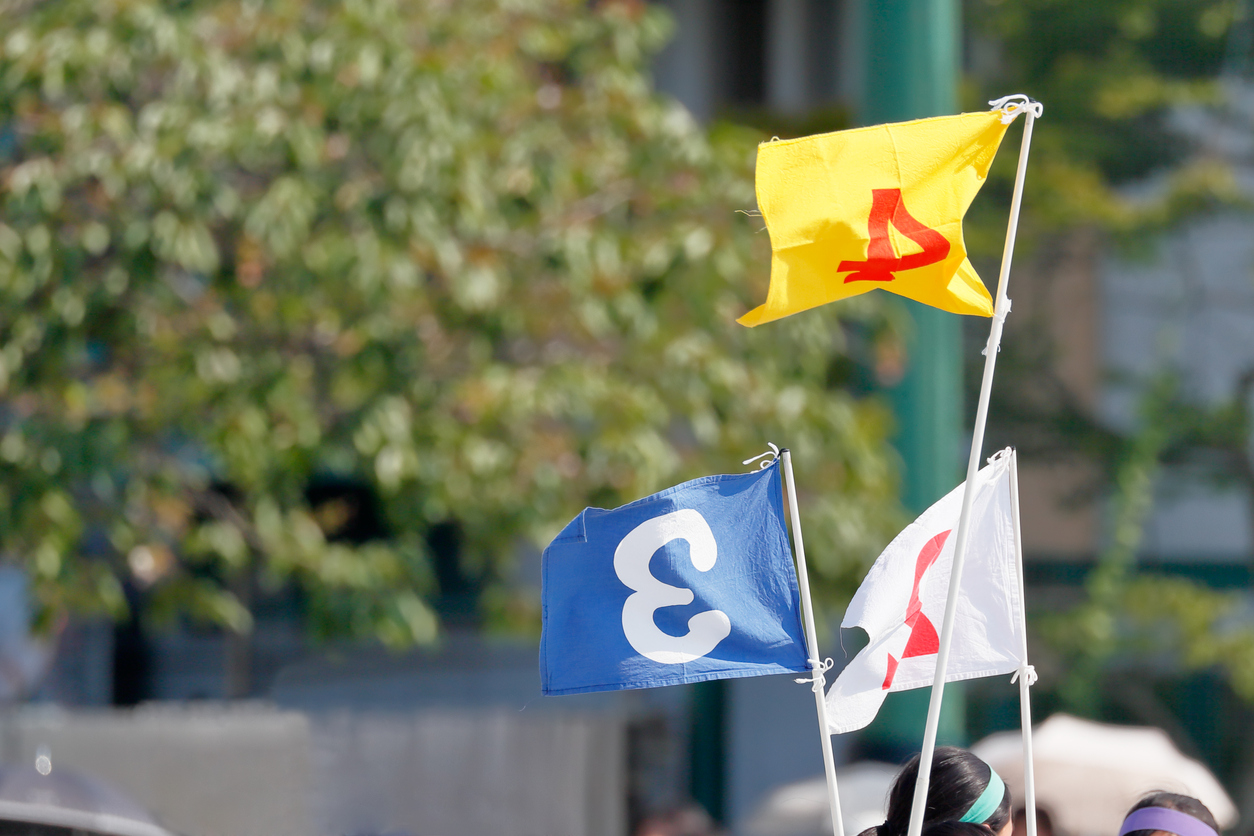
The effectiveness of an Undokai lies in its inclusivity and the immediate feedback loop of the activities. Unlike high-intensity sports, these events are designed so that athletic ability is not the sole determinant of success. Instead, success depends on communication, role allocation, and collective strategy.
15 Essential Undokai Activities for the Modern Workplace
These traditional Japanese events have been curated based on their popularity and their ability to be scaled for adult participants.
1. Ball Toss,Tama-ire; A staple of Japanese field days, “Tama-ire” requires teams to toss small beanbags into a high basket. While it appears simple, it serves as an excellent exercise in collaborative goal setting. Modern variations include “moving baskets” or defensive players, requiring teams to adapt their strategy in real-time.
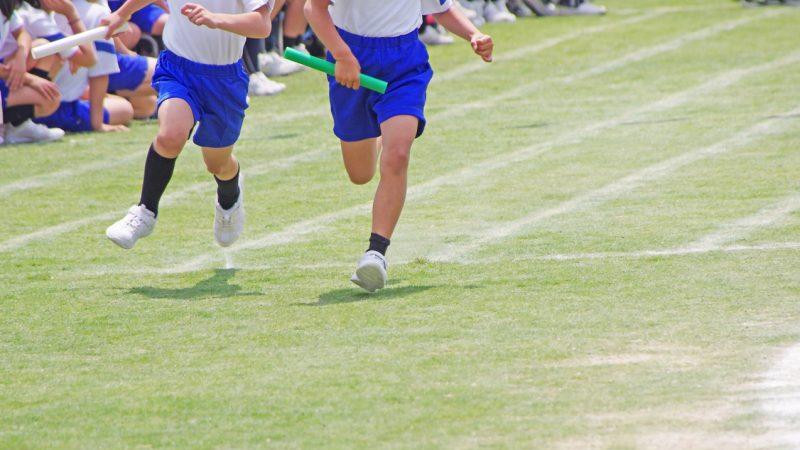
2. Team Relays; The relay race remains the centerpiece of any Undokai. The focus here is not just individual speed but the “baton pass,” which serves as a powerful metaphor for seamless project handoffs and cross-departmental collaboration.
3. Tug of War, Tsunahiki; This classic test of strength is transformed into a strategic exercise when teams must coordinate their timing and positioning. It teaches participants that collective, synchronized effort is far more powerful than individual strength alone.
4. Cavalry Battle, Kiba-sen; Traditionally a high-stakes competition where teams of four form a “horse” to capture an opponent’s hat, this event has evolved. Due to modern safety standards, it is often replaced by safer, more inclusive versions, yet it remains a classic example of physical coordination and defensive strategy.
5. Footraces, Tokyoso; Short sprints are often modified into scavenger hunt races, “Karimono-kyosou”, where runners must find specific items or people based on a prompt. This levels the playing field, making the race about quick thinking and social interaction rather than just raw speed.
6. Obstacle Courses; These courses challenge participants to navigate various physical hurdles. For the observers, it provides high entertainment value, while participants practice resilience and problem-solving under pressure.
7. Performance and Cheering Squads; Derived from Japanese folk dances like “Soran Bushi”, this activity focuses on team identity. Teams create unique cheers or coordinated movements, fostering a shared culture and boosting morale through creative expression.
8. Giant Ball Roll, Oodama Korogashi; Teams of two to four people work together to navigate a massive inflatable ball through a course. It is a highly visual activity that emphasizes communication and shared vision, as participants must stay in sync to maintain momentum.
9. Pole Topple, Bo-taoshi; A traditional game of offense and defense where teams attempt to tip over the opponent’s pole. While its intensity has led to fewer appearances in schools, it remains a masterclass in role distribution, dividing a team into clear attack and defense units.
10. Giant Ball Pass, Oodama Okuri; Participants line up and pass a giant ball over their heads without letting it touch the ground. The thrill of the ball moving rapidly overhead requires intense focus and provides a significant team win feeling upon completion, making it a great choice for events with limited preparation time.
11. Long Rope Jumping,Oonawa Tobi; A group of ten or more jumps a single large rope in unison. This activity provides one of the highest team-building returns, as success is impossible without every member finding a common rhythm.
12. Stick Pulling, Bo-hiki; Teams compete to pull wooden poles from a center zone back to their own territory. It requires explosive starts, known as explosive power, and tactical decision-making regarding which “assets” (poles) to prioritize.
13. Three-Legged Race, Ninin Sankyaku; By tying their ankles together, pairs must find a shared gait to reach the finish line. This is particularly effective for pairing employees from different departments or seniority levels to build interpersonal trust.
14. Eye of the Typhoon,Taifu no Me; A team of four or five runs while holding a long pole, pivoting around cones. The physics of the turn—where the outermost runner must cover more ground—demands that the team understands their individual roles and supports each other’s pace.
15. The Grand Finale, Kusudama-wari; Teams throw balls at a decorative overhead sphere until it bursts open. It serves as a visual climax for the day and can be customized to reveal company slogans or new products, creating a memorable “big reveal” moment.
Strategic Innovations: 6 Modern Variations for Corporate ROI
Beyond the classics, several “New Sports” have been developed to specifically target corporate needs like psychological safety and innovative thinking.
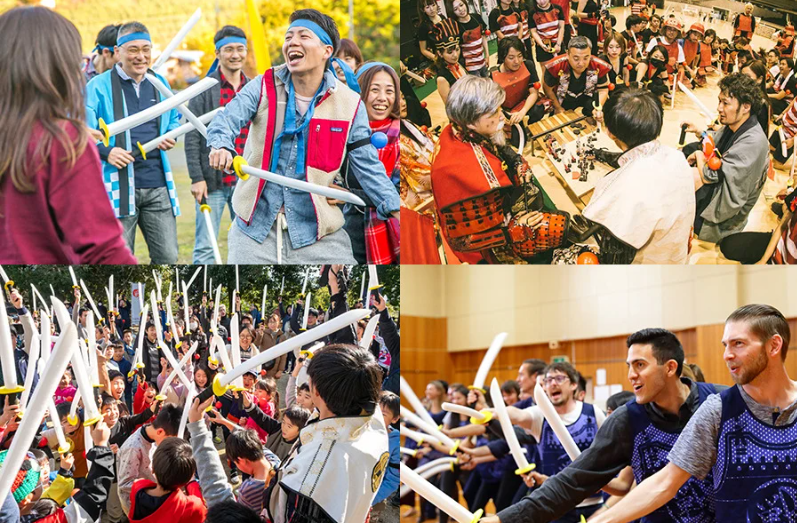
・SAMURAI BATTLE / Chanbara Battle: This high-energy activity uses foam swords to knock a ball off an opponent’s arm. It is preceded by a “Gungi,” or military council, where teams must debate and finalize their tactics. It is safe, inclusive, and provides a deep dive into strategic planning.
⇒Download our SAMURAI BATTLE / Chanbara Battle guide.
・Giant Pants Relay, Dekapan-kyosou: Two people share a single pair of oversized trousers to run a relay. The inherent humor lowers social barriers and forces a high level of physical synchronization.
・Moving Ball Toss, Oikake Tama-ire: Instead of a tarp, a member of the opposing team wears the basket on their back and runs away. This adds a layer of dynamic problem-solving to the traditional game.
・Giant Ball Transport: Four people carry a giant ball on a tarp. If the ball falls, the team loses time, emphasizing that “slow and steady” often wins the race in complex projects.
・Dice Relay: Runners roll a large die and must run to the cone corresponding to the number rolled. This introduces an element of luck that levels the playing field between athletic and non-athletic participants.
・Caterpillar Race: Pairs move inside a loop of cardboard like a tank tread. It requires total alignment of movement and creates a shared, often hilarious, struggle that bonds participants.
Specialized Undokai Formats for Targeted Goals
Depending on your organizational objectives, these themed formats can provide specific cultural or educational benefits:
・Samurai Undokai: Japan’s Team Sports Festival: A themed event focusing on flat hierarchies and “Warring States” era strategy. It is ideal for breaking down seniority barriers.
⇒Download our Samurai Undokai: Japan’s Team Sports Festival guide.
・Disaster Preparedness Games: This format teaches life-saving skills through games, such as the “Debris Transport” relay. It combines corporate social responsibility with practical team training.
・The Socially Distanced Safe Undokai: Designed for physical distancing, this format uses 2-meter batons and individual-play rules to ensure safety without sacrificing the fun of a live event.
・Remote Undokai: For global or distributed teams, these online events use home-based challenges to foster verbal communication and “soft” management skills.
Conclusion: Turning Play into Performance

The Japanese Undokai is more than a relic of school days; it is a sophisticated framework for building resilient, communicative, and happy teams. By choosing activities that prioritize cooperation over competition, you can ensure that every employee, regardless of their physical prowess, leaves the field feeling like a valued member of the organization.
Would you like me to create a sample itinerary for a one-day Undokai tailored to a specific team size or corporate goal?
⇒Download our comprehensive guide.