In today’s multi-cultural and hybrid workplaces, traditional team building often feels forced or exclusionary. Enter Word Wolf, a Japanese social deduction game that transforms casual conversation into a high-impact tool for building trust and emotional intelligence (EQ). Word Wolf relies entirely on verbal communication and psychological strategy, making it accessible to everyone regardless of fitness level or language fluency. Backed by IKUSA’s expertise in executing over 1,400 events annually, this guide shows how to strengthen communication and build trust in global teams.
⇒Download our comprehensive guide.
What is Word Wolf?

Word Wolf is a “social deduction” game where participants engage in conversation to identify a minority member holding a different secret keyword. While it shares roots with the popular “Werewolf” game, it offers a unique twist that makes it far more effective for corporate settings.
In Word Wolf, no one knows if they are the “Wolf” (Minority) or a “Citizen” (Majority) at the start. Everyone begins on equal footing, gauging the room to determine whether they are in the Majority or Minority. The game focuses on discovering the minority through natural dialogue, making it an ideal communication training exercise rather than just a game of luck.
How to Run Word Wolf for Corporate Teams
Divide participants into groups of 6 to 8 and distribute keywords via app or cards—most players receive the same word (Majority), while one or two receive a different word (Minority). Set a timer for 3 to 5 minutes depending on group size. During this time, players discuss the topic without directly stating their keyword, carefully gauging whether they’re in the Majority or Minority.
The challenge lies in balancing revelation with concealment. Reveal too much and you expose yourself as the Wolf; reveal too little and you appear suspicious. When time expires, everyone simultaneously points to their suspected Wolf. If the Majority catches even one Wolf, they win; if the Wolf evades detection, the Minority wins. This quick resolution makes Word Wolf more suitable for corporate time constraints than traditional elimination-style games.
Strategic Tips for High-Level Engagement
Winning at Word Wolf requires more than just talking—it demands a balance of logic, intuition, and psychological awareness. The best players begin with vague, universal questions like “Is it sweet?” or “Do people use this daily?” These safe probes let you gauge reactions without exposing your specific keyword. As the conversation progresses and you gain confidence about your position, you can gradually introduce more specific details, but always leave yourself plausible deniability.
The moment you realize you’re the Wolf is critical. Resist the urge to freeze or change your tone—any sudden shift in energy will betray you. Instead, seamlessly adjust your language to mirror the Majority’s descriptions. If they’re emphasizing “coldness,” lean into temperature metaphors. If they focus on “texture,” shift your contributions accordingly. The best Wolves don’t contradict; they redirect.
If you’re confident you’re in the Majority, shift from speaking to observing. Watch for players who pause fractionally before answering, who give descriptions that are technically accurate but feel slightly “off,” or who ask questions that seem to fish for information rather than confirm it. These micro-hesitations—a quick glance away, a half-second delay, an overly careful word choice—are your best clues. In cross-cultural teams, be aware that hesitation patterns vary; what reads as suspicious in one culture may simply be thoughtful communication in another.
The Impact: Why HR Leaders Love Word Wolf
Beyond the immediate fun, Word Wolf delivers measurable organizational benefits that justify its place in professional development budgets. Participants instinctively learn to read micro-expressions, vocal tone shifts, and hesitation patterns—the same non-verbal cues that determine success in client negotiations, performance reviews, and cross-cultural collaboration. Unlike traditional EQ workshops that teach these skills abstractly, Word Wolf provides immediate, repeated practice in a low-stakes environment where mistakes feel playful rather than career-threatening.
The game also disrupts typical meeting dynamics that favor extroverts and native speakers. By creating a structured speaking order where silence isn’t an option, Word Wolf forces introverted team members to engage. These quieter voices often surprise everyone by excelling at the strategic questioning the game rewards, revealing hidden communication strengths that carry over into regular meetings. You’ll discover the analyst who asks brilliant clarifying questions, the designer who reads body language fluently, and the engineer who stays ice-cold under pressure.
HR leaders consistently report that Word Wolf reveals leadership dynamics their formal assessments miss. Within 10 minutes, you’ll see who naturally takes charge, who asks questions that move the group toward consensus, who panics under ambiguity, and who thrives in it. These insights inform succession planning, project team composition, and coaching priorities.
Beyond Word Wolf: 5 Ways to Experience “Real” Japanese Team Building by IKUSA
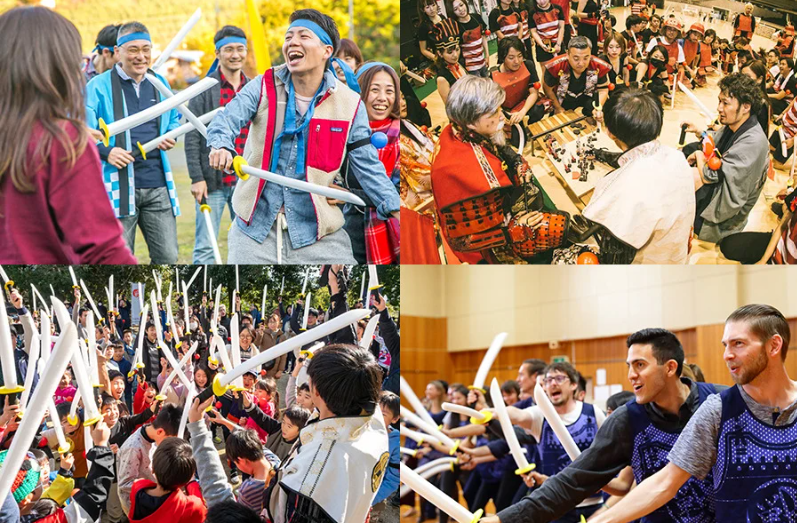
Word Wolf works brilliantly as a standalone icebreaker, but what if your team is ready for something more immersive?
With over 1,400 events delivered annually for global companies, IKUSA has refined Japanese cultural traditions into professional team building programs designed for international teams. Every program includes English-speaking facilitators.
Below are five flagship programs that go beyond typical team building, combining physical engagement, strategic thinking, and authentic cultural immersion.
The ultimate flagship activity. Using soft sponge swords, teams engage in strategic combat that mimics a PDCA cycle (Plan-Do-Check-Act), requiring intense “Gungi” (strategy meetings) between rounds.
⇒Download our SAMURAI BATTLE / Chanbara Battle guide.
Immerse your team in the world of “Shinobi”. This high-energy game uses simple, intuitive rules that bypass all language barriers, making it perfect for diverse global groups.
⇒Download our NINJA BATTLE guide.
A hybrid of Japan’s traditional school sports day and Samurai themes. It fosters organizational unity through unique, high-octane team challenges like “Giant Ball Rolling”.
⇒Download our Samurai Undokai: Japan’s Team Sports Festival guide.
A barrier-free, stationary activity focusing on high-quality craftsmanship. Participants can try on genuine heavy armor or create original samurai tools, providing a high-impact “authentic” experience for VIP parties.
⇒Download our Samurai Heritage Workshop guide.
A high-stakes negotiation simulation where teams must reach an agreement under “zombie pandemic” or “jungle survival” conditions. This program is the gold standard for leadership and cross-cultural decision-making training.
⇒Download our SURVIVAL CONSENSUS guide.
Mastering the Art of Consensus and Logic

Strategic games like these are more than just entertainment; they are essential tools for fostering collective intelligence and role distribution within a team. With support for professional English-speaking MCs and inclusive program designs, IKUSA ensures that every team member can participate effectively, regardless of their linguistic background or physical ability. With a track record of over 1,400 successful events, we specialize in turning psychological theory into an engaging reality. Ready to elevate your team’s synergy through a unique and inclusive experience in Japan?
⇒Download our comprehensive guide.