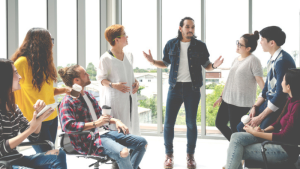
In today’s fast-paced corporate environment, the warming up phase of a meeting is often dismissed as a luxury. However, high-performing teams in North America and Europe are increasingly recognizing that the first 10 minutes determine the ROI of the next two hours.
Effective icebreakers do more than just break the ice—they reduce social friction, establish psychological safety, and prime the brain for creative problem-solving. In Japan, this is often linked to the concept of Ishindenshin (a Japanese term for interpersonal communication through unspoken mutual understanding), where teams align their thinking patterns to achieve seamless execution.
Here are 10 professional icebreakers designed to sharpen your team’s cognitive edge and foster genuine collaboration.
⇒Download our comprehensive guide.
10 Brain-Training Icebreakers for Modern Teams

1. Personality Insights (Psychological Testing)
This is a quick psychological assessment that reveals individual traits and values through hypothetical choices.
- How to play:
- Prepare a brief, lighthearted psychological test or scenario.
- Present the question to the group and have everyone choose their answer.
- Reveal the personality traits or thinking styles associated with each choice.
This activity creates immediate curiosity and allows team members to understand each other’s diverse perspectives and deep-seated thinking styles without feeling intrusive. It builds the foundation for empathy, which is essential for long-term psychological safety.
2. The Plain English Challenge (No-Jargon Game)
This is a linguistic puzzle where players explain complex business concepts using only everyday, non-technical vocabulary.
- How to play:
- One person is given a complex business term (e.g., Blockchain or Synergy).
- They must describe the term without using any industry jargon or the word itself.
- The rest of the team guesses the term.
This game encourages the brain to find creative synonyms and improves communication clarity across departments. By stripping away buzzwords, it ensures that your team can convey complex ideas simply—a vital skill for cross-functional collaboration.
3. Professional Charades (Gesture Game)
This is a non-verbal challenge where participants act out office-related scenarios using only gestures and facial expressions.
- How to play:
- A participant is given a prompt, such as a common office struggle or a professional goal.
- They must act it out using only body movements and facial expressions—no speaking allowed.
- The team competes to guess the action within a time limit.
Non-verbal communication accounts for a vast majority of human understanding. This game builds empathy and observational skills, highlighting how much we can communicate through tone and presence even before we speak.
4. The Team Standard (Consensus Guessing)
This is a consensus-building exercise focused on predicting a teammate’s personal definition of a standard or norm.
- How to play:
- Ask a subjective question like, “What is the ultimate office snack?” or “What is the best time for a meeting?”
- One player (the Standard) secretly writes down three answers they consider the norm.
- The rest of the team tries to guess exactly what the Standard chose.
This activity reveals the group’s unspoken norms and hidden similarities between diverse team members. It is an excellent way to visualize how aligned (or misaligned) a team’s internal compass is in a low-stakes environment.
5. Cognitive Interference (Reverse Rock-Paper-Scissors)
This is a fast-paced reflex game that challenges the brain by inviting participants to intentionally lose a round of Rock-Paper-Scissors.
- How to play:
- Participants pair up and play a standard game of Rock-Paper-Scissors.
- The catch: The person who goes second must lose on purpose.
- Switch roles and increase the speed for a bigger challenge.
This is a pure brain-training exercise that prompts the prefrontal cortex to override a lifetime of winning instincts. It sharpens mental agility and focus, effectively waking up the brain for the analytical tasks ahead.
6. The Social Deduction Challenge (Word Wolf)
This is a strategic discussion game where the team must identify an imposter who has been given a slightly different keyword from the rest of the group.
- How to play:
- Most players receive the same word (e.g., Coffee), but one Wolf receives a slightly different word (e.g., Tea).
- Players discuss the topic for 3 minutes without naming the word directly.
- The group must identify the Wolf based on subtle inconsistencies in their description.
This game trains critical observation and information analysis skills. It mimics real-world strategy meetings where identifying misalignments and analyzing data nuances are key to risk management.
7. The Nuance Master (The Ha?! Game)
This is an emotional intelligence drill focused on detecting subtle vocal tones and facial cues through a single word.
- How to play:
- A player is given a single word (e.g., Really?) and a hidden emotional prompt (e.g., Excited, Disappointed, or Doubtful).
- They say the word once using that specific nuance.
- Others guess the emotion based on the delivery.
This activity significantly improves emotional intelligence (EQ). It is particularly effective for remote teams, as it trains members to become more sensitive to vocal tone and facial expressions during virtual interactions.
8. Visual Chain (Picture Shiritori)
This is a collaborative drawing game that requires teams to link a series of images without using any words or text.
- How to play:
- The first person draws an object on a digital or physical whiteboard.
- The next person must draw something that starts with the last letter of the previous object.
- No speaking or writing words is allowed.
This promotes non-verbal synchronization and tests how well a team can stay aligned toward a goal under time pressure. It encourages a shared creative flow, which is a precursor to innovative problem-solving.
9. Global Trivia Flash
This is a competitive quiz that tests the team’s knowledge of diverse cultural, scientific, and professional facts.
- How to play:
- The facilitator presents quick-fire trivia questions about global culture, science, or local history.
- For example: “What is the oldest recorded sweet in Japan?” (Answer: Cookies from the Jomon era).
- Participants answer individually or in small breakout groups.
Shared knowledge and intellectual curiosity increase a sense of belonging. This is an inclusive way to level the playing field, allowing participants to share their expertise on topics outside of their daily work responsibilities.
This is a collaborative problem-solving mission where teams must decode riddles and share information to escape a themed scenario.
- How to play:
- The team is presented with a complex mystery or a digital escape room scenario.
- Participants are given fragmented information that must be pieced together to find the solution.
- The game is played against a clock to simulate a high-pressure environment.
This functions as a full-scale simulation of collective intelligence. It requires a clear PDCA (Plan-Do-Check-Act) cycle, leadership, and rapid information sharing. Professional facilitators provide ready-to-use kits and facilitation support, ensuring that all participants—regardless of their native language—can contribute to the solution safely and effectively.
⇒Download our THE ENIGMA ESCAPE guide.
Scalable Workshops for Team Transformation
While quick icebreakers are excellent for daily meetings, deeper cultural transformation requires more immersive experiences. To support this journey, We provide high-ROI training designed for the global workforce:
This is a physical, high-energy activity where participants wear life-indicators (balls) on their arms and use soft sponge swords to engage in a peaceful battle. By alternating between the Battle and the War Council (Strategy Meeting), teams experience a rapid PDCA cycle that sharpens their collective decision-making and leadership. It is designed to be fully inclusive; those who prefer not to engage in physical movement can take on vital roles as Strategists or Commanders, ensuring every member contributes to the victory.
⇒Download our SAMURAI BATTLE / Chanbara Battle guide.
This is a sophisticated decision-making simulation where teams must reach a group consensus on which items are vital for survival in extreme scenarios, such as a Zombie Pandemic or a Jungle Crash. The workshop moves beyond simple cooperation to teach Assertive Communication. Participants learn to navigate conflicting opinions to ensure that the best logical idea wins—not just the loudest voice—making it a perfect fit for leadership development.
⇒Download our SURVIVAL CONSENSUS guide.
Virtual Escape: The Digital Synergy Mystery
This digital-first teambuilding experience is specifically engineered for the modern hybrid workforce, using high-end production and professional facilitators to bridge the distance between remote employees. Teams are immersed in a virtual world where they must collaborate and share fragmented information to solve a larger puzzle. This builds the foundation for seamless communication in an environment where non-verbal cues are often limited, fostering a strong sense of unity across different time zones.
Ready to Sync Your Team?

Whether you are managing a local startup or a multinational corporation, the goal of team building remains the same: to understand each other better so you can perform better. At IKUSA, we specialize in combining Japanese cultural wisdom with rigorous professional methodologies. We have supported over 1,000 events annually, providing everything from English-speaking facilitators to seamless event coordination.
⇒Download our comprehensive guide.