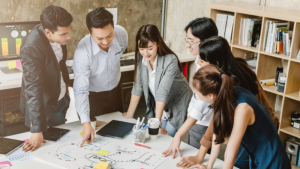
For many modern employees, the phrase “company trip” brings to mind awkward bus rides and mandatory drinking sessions. However, when executed correctly, a corporate retreat is one of the most effective tools for breaking down silos and improving psychological safety.
According to industry data, offsite events remain a staple for high-performing organizations, with 27.8% of companies implementing them. The goal has shifted from simple “leisure” to strategic team building. Whether you are a multinational team based in Japan or planning an inbound corporate retreat, the activities you choose define the ROI of the event—impacting communication, engagement, and retention.
Here is a comprehensive guide to 25 effective corporate retreat ideas, categorized by their primary objective.
⇒Download our comprehensive guide.
Category 1: Communication & Engagement
Best for breaking the ice and mixing diverse teams.
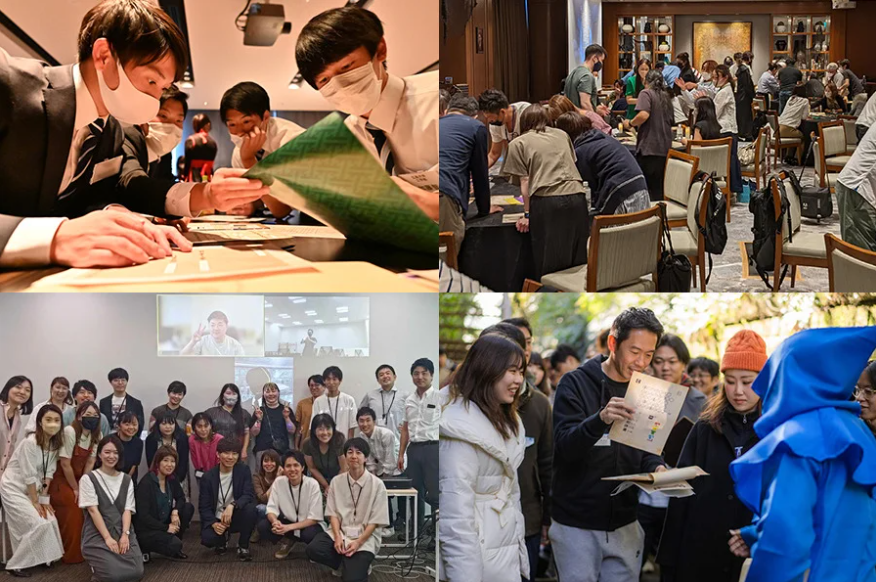
Participants become protagonists in a story, working together to solve riddles and escape a locked room (or scenario) within a time limit. This activity necessitates communication, as no single person holds all the answers.
This activity transforms a standard meeting room into a high-stakes training ground, such as escaping from a “Burning Temple.” The puzzles are structurally designed to mandate collaboration; since no single member can solve them alone, leadership and teamwork emerge naturally.
2. Offsite Meeting
Holding a meeting in a non-traditional setting—such as a resort or nature retreat—can drastically improve the quality of the discussion. The change in environment helps participants refocus, leading to more frank and creative exchanges.
Removing the team from the daily office grind creates a psychological shift that sparks creativity and fresh perspectives. Isolating the team from daily interruptions allows for deep-dive strategy sessions, while the relaxed atmosphere encourages open discussions where junior staff feel comfortable speaking up regardless of hierarchy, fostering genuine psychological safety.
3. Quiz Tournament
A classic format where teams compete to answer questions. For corporate groups, creating custom quizzes about the company history or employee trivia can spark laughter and mutual interest.
The content is highly customizable, allowing companies to tailor questions to their corporate history or internal trivia, which effectively reinforces corporate culture. The competitive element naturally generates excitement and laughter, while the lack of physical skill requirements ensures that it is completely inclusive for employees of all ages and abilities, making it an ideal icebreaker for diverse groups.
This is a roaming puzzle-solving activity where teams navigate a city or tourist destination. Using a messaging app like LINE, teams receive missions that require them to move to specific locations (Physical), solve riddles (Intellectual), and take creative photos (Cooperative).
This program perfectly blends sightseeing with team building, allowing teams to explore the destination while achieving specific mission goals. Solving location-based riddles creates a unique shared experience and memory that a standard tour cannot match.
A large-scale interactive event that utilizes professional facilitators and digital quiz systems. Participants join via smartphones, making it easy to engage large groups instantly. The ranking system updates in real-time, creating a TV-show-like atmosphere.
Utilizing professional facilitators and digital systems elevates the event from a standard “meeting” to an exciting “TV show” experience. It offers massive scalability, accommodating hundreds of participants simultaneously—even in hybrid or online formats. Best of all, outsourcing the question creation and operation allows HR managers to enjoy the event alongside their teams without the administrative burden.
A visual exploration game where teams must find specific items or scenes to fill a 25-square bingo card. Missions often involve taking photos in specific poses or finding local landmarks.
The visual nature of the photo missions—such as “take a photo jumping”—makes this activity barrier-free and perfect for multilingual teams. It requires strategic thinking as teams must decide the most efficient route to clear lines on the bingo card. The output is a gallery of fun, high-quality team photos that can be shared internally to boost morale long after the trip.
7. Local Rating Battle (kakuzuke)
Based on a popular Japanese TV format, this activity challenges participants to distinguish “top-tier” local delicacies from cheaper alternatives through blind tasting. For example, distinguishing high-grade crab from imitation crab.
This activity directly incorporates local food culture into the entertainment, turning a dinner into an engaging experience. It levels the playing field significantly, as success relies on sensory perception rather than business hierarchy or tenure. As a turnkey solution managed by professional staff and facilitators, it ensures a high-quality banquet experience where everyone can relax and interact freely.
8. Team Building BBQ
This is not a passive meal, but a collaborative project. Services provide a “hands-free” experience where ingredients and equipment are ready, but teams must work together to cook.
The act of cooking together breaks down formal barriers much more effectively than a formal sit-down dinner, fostering natural conversation. The experience is enhanced by gamified elements, such as weight-guessing or curry-seasoning battles, which add a competitive layer to the meal. It is a hassle-free, full-service option that handles everything from setup to trash removal, allowing teams to focus purely on connection.
A simulated casino experience using professional tables and dealers. Unlike gambling, this is a game of resource management and strategy. It uses mock currency, making it a risk-free way to observe how colleagues handle pressure and investment.
Professional dealers and authentic equipment create a luxurious, high-end vibe that is perfect for gala dinners. The game focuses on chip management and calculated risks without real financial stakes, revealing the strategic thinking of your employees.
Category 2: Strategic Team Building
Best for analyzing team dynamics and improving collaboration.
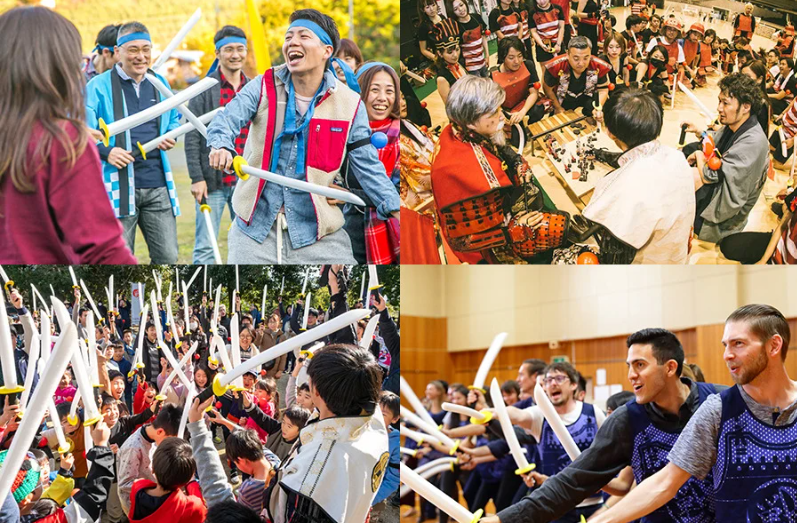
Safe, strategy-focused combat using soft foam swords. Participants attach a “life ball” to their arm, and the goal is to knock off the opponent’s ball. It combines physical activity with the “PDCA cycle”—teams must hold a strategy meeting, “Gun-gi” ( before each round to improve their tactics.
This activity is a physical application of the PDCA cycle; the sequence of “Battle, Strategy Meeting, and Battle” rapidly improves team coordination and communication. It is designed for safety and inclusivity, using soft equipment and offering roles like “Commander” so that non-athletic members can lead. Furthermore, wearing authentic Samurai coats provides a unique cultural immersion that delights international participants.
11. Uninhabited Island Trip
A survival-style retreat where teams camp on a secluded island. Setting up tents, cooking over fires, and managing limited resources strips away corporate titles and fosters raw, genuine human connection.
Removing digital distractions and placing the team in nature forces them to focus entirely on each other and the task at hand. The process of overcoming physical challenges—such as building shelter or starting a fire—creates deep, lasting bonds that office life cannot replicate. In this raw environment, true leadership qualities and hidden strengths emerge naturally, often redefining the team dynamic.
12. The All-In Mega Puzzle Challenge
A game that combines jigsaw puzzles with riddles. It utilizes the “Jigsaw Method,” where different members hold different pieces of information. Success is impossible unless everyone shares their clues, forcing communication across silos.
This game is structurally designed to break down silos; it requires information sharing, making it impossible for “lone wolves” to succeed on their own. The missions are highly customizable and can be tailored to include Corporate messages or specific learning goals. Its flexible format allows it to be conducted in banquet halls, meeting rooms, or even online, making it adaptable to any trip itinerary.
This transforms a childhood pastime into a strategic sport. Using official rules, teams use barriers for cover and aim to capture the opponent’s flag. It requires clear roles: forwards for attack and backs for defense.
Far from simple play, this sport requires tactical depth with clear role definitions (offense vs. defense) and coordinated execution. The game is played in a controlled environment with official rules and referees to ensure safety and fairness. It also utilizes Japan’s unique winter environment, providing a memorable seasonal experience that builds camaraderie.
14. Detective Challenge: The Crime Scene Investigation
A logic-based game where participants gather fragmented information to solve a complex case. It emphasizes information analysis and uses the “Jigsaw Method” to force collaboration.
This activity serves as excellent logical training, enhancing critical thinking and data analysis skills within a group setting. It facilitates active discussion and consensus-building, as teams must debate to reach the “truth.” Furthermore, it requires team members to organize disparate information, effectively practicing and improving their meeting facilitation skills.
Category 3: Training & Development
Best for leadership, innovation, and skill acquisition.
15. Overseas Inspection Trip
Visiting international headquarters, factories, or industry hubs (like Silicon Valley). This provides a macro-perspective on the business and helps employees understand their global standing, sparking innovation upon their return.
This experience exposes employees to global standards and market trends firsthand, providing a perspective that cannot be gained from a desk. Seeing different operational methods often acts as an innovation trigger, sparking new ideas for the home office. Additionally, being selected for an overseas trip serves as a significant reward, boosting motivation and loyalty among top performers.
16. Experience-based Battle Training (Castle Defense)
An evolution of the Chanbara Battle, this version adds a resource management layer. Teams must earn “gold” to buy materials (cardboard) to build a physical castle. They then defend their fortress in battle. It simulates a business cycle: earn resources, invest in infrastructure, and execute strategy.
This is a comprehensive business simulation that teaches the full cycle of earning, budgeting, investing, and executing a strategy. It uniquely combines physical crafting—building castles—with active strategy, engaging both creative and tactical minds. The session includes professional feedback from a “Military Advisor,” providing valuable insights into team dynamics and leadership styles.
17. Tactical Survival Challenge
A survival game (using airsoft or laser tag) designed to teach the OODA Loop (Observe, Orient, Decide, Act). This framework helps teams make rapid decisions in changing environments, a critical skill for modern business agility.
This training focuses on agile decision-making, teaching teams to act quickly in rapidly changing “combat” situations using the OODA Loop framework. It provides the thrill of combat sports while maintaining a safe environment with strict safety measures and professional instruction. The process highlights the importance of clear commands and adaptability, making it an effective tool for practical leadership development.
18. Mini Awards Ceremony
Recognizing employees in a relaxed travel setting can be more impactful than in the office. Awards can range from serious “Sales MVP” to lighthearted “Mood Maker” titles, reinforcing a culture of appreciation.
Visibly rewarding hard work in this setting boosts morale and retention by fostering a culture of appreciation. Using a voting system for awards encourages peer recognition, allowing employees to acknowledge each other’s strengths. The relaxed travel setting often leads to more genuine, emotional speeches, deepening the emotional connection between team members.
19. World Leaders (SDGs Business Game)
A simulation game where teams manage companies while trying to achieve Sustainable Development Goals. It demonstrates the balance between profit and social responsibility.
This game teaches strategic sustainability, demonstrating that business growth and social contribution are not mutually exclusive but complementary. It involves complex negotiation with other teams, accurately simulating real-world business ecosystems. The format allows junior staff to experience the high-level decision-making of a CEO, managing labor and capital to broaden their management perspective.
A tabletop simulation where teams must reach an agreement on items needed for survival in extreme scenarios, such as a “Jungle Plane Crash” or “Zombie Pandemic.”
This activity is designed to master the art of agreement under pressure, requiring teams to prioritize items logically while managing conflicting opinions. It highlights the importance of listening and logical persuasion, making it an excellent training tool for improving decision-making quality. The dramatic scenarios (like Zombie Survival) keep the energy high and engaging compared to traditional classroom training.
Category 4: Wellness & Activity
Best for health, stress relief, and physical bonding.
21. Rafting
A thrilling river sport where teams navigate a raft downstream using paddles. It requires synchronized movement and listening to the river guide’s commands.
Navigating rapids requires synchronized paddling and absolute trust in teammates, fostering an immediate sense of unity that “we are in the same boat.” The refreshing outdoor environment of Japan’s rivers reduces stress and refreshes the mind. It is a shared thrill that creates a lasting emotional bond among team members.
22. Corporate Sports Day (Undokai)
A traditional Japanese field day adapted for companies. It includes events like tug-of-war, relay races, and unique team challenges, often wearing matching headbands or bibs.
This event is powerful for flattening the corporate hierarchy, as executives and new hires compete on equal footing in a fun, nostalgic atmosphere. It promotes inclusivity by including non-athletic games (like “Giant Bale Rolling” or “Obstacle Courses”) so everyone can participate. The shared cheering and competition significantly boost company morale and unity.
23. Samurai Water Battle
A summer version of the “Chanbara Battle” using water guns. Participants aim at targets on opponents’ chests or helmets. It is a cooling, high-energy activity perfect for hot seasons.
This visually striking event is highly refreshing and perfect for summer retreats, combining the strategy of battle with the fun of water play. It is extremely safe and has a low barrier to entry, making it suitable for diverse groups, including those with families. The visual spectacle of the water fight creates fun, energetic memories for the entire team.
24. Health Tourism (Wellness Retreat)
Trips focused specifically on physical and mental recovery, such as yoga retreats, forest bathing , or healthy culinary tours.
By focusing on activities like yoga, forest bathing, or healthy eating, this program directly addresses the growing issue of employee burnout. It encourages employees to disconnect from technology and focus on personal well-being and mindfulness. This investment in health demonstrates the company’s care for its employees, promoting long-term sustainable performance and loyalty.
5 Keys to Planning a Successful Corporate Retreat

To ensure your event is a strategic investment rather than a mere expense, follow these planning principles:
- Define the Purpose: Is the goal to fix communication issues, reward performance, or train leadership? The activity aligns with your strategic intent.
- Involve the Team: Use surveys to gauge interest. Forcing physical activities on a team that prefers logic puzzles can be counterproductive.
- Offer Choices: For multi-day trips, allow a mix of mandatory team building and “free choice” time (e.g., Golf vs. Spa vs. Sightseeing) to respect individual preferences.
- Prioritize Experience: Replace passive sightseeing with active “Experience-based” activities. This creates shared memories that last longer than a bus tour.
- Communicate Transparently: Reduce anxiety by providing detailed itineraries, packing lists, and safety information well in advance.
Ready to transform your next company trip? From Samurai Battles to Strategic SDG Simulations, IKUSA provides unique, English-supported team building experiences across Japan. We provide end-to-end support from venue coordination to professional facilitators.
⇒Download our comprehensive guide.